The Clock Is Ticking, but the Table Isn’t Listening: Maguire’s Maximums in a Faster 2026
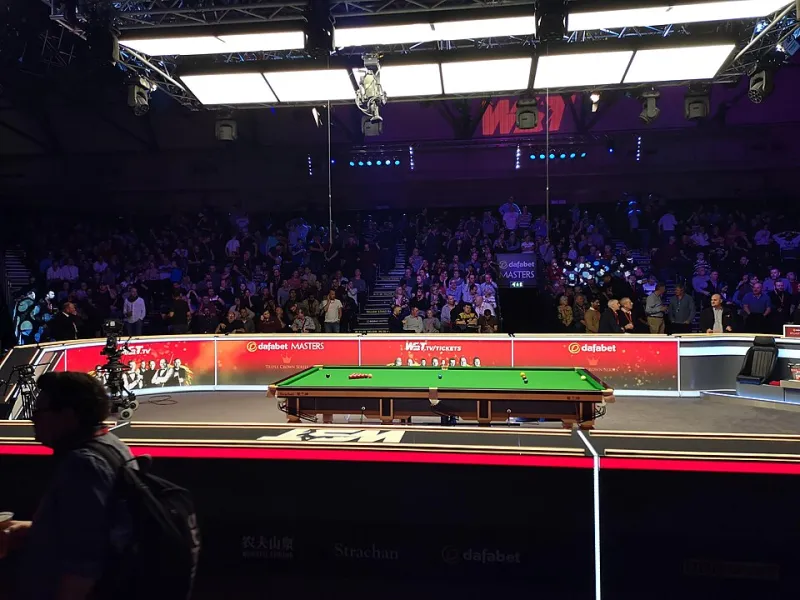
Photo: Krangsbody, CC BY-SA 4.0, via Wikimedia Commons
Stephen Maguire has never been a player who needs a stopwatch to tell him the frame is moving. You can see it in the way he circles the table, chalk in hand, eyes already mapping the next three pots before the first one drops. The rhythm is the thing. Not the speed, exactly — the rhythm. And in a 2026 snooker season that keeps getting tighter, faster and more broadcast-friendly, that distinction matters more than ever.
The Romance of the Long Build
A maximum break is not a sprint. It is a conversation with the table. The first red is a question; the black is the answer; the pack split is the moment where the conversation either opens up or closes down. A 147 needs patience as much as precision. It needs a player willing to walk around the table, re-check the angle, resist the easy pot and take on the one that keeps the break alive.
That is the romance of it. The crowd knows it. The commentators know it. Even the players who insist they never think about a maximum know it, somewhere in the back of their minds, when the reds start to spread and the black keeps landing perfectly.
But romance is not what pays for the arena lights. The commercial push across the 2026 calendar is for pace: shorter formats, tighter scheduling, broadcast windows that do not wait for a safety exchange to resolve itself. Shot clocks remain largely confined to the Shoot Out and similar events, but the mood music is unmistakable. Snooker is being asked to move faster.
Where the Clock Actually Bites
Here is the thing about a shot clock: it rarely bites on the easy shots. A player can see a straightforward red, drop it in, and move on. The clock bites at the decision points. The split. The risky red to keep the break going. The choice between a safety exchange and a speculative double. The moment when a player has to decide whether the maximum is still on, or whether the frame demands something more pragmatic.
Those are exactly the moments where a 147 is made or lost. A shot clock does not stop a player thinking. It stops him thinking twice. And thinking twice is often what separates a 60 break from a 147.
For Maguire, the case study is useful because his maximum instinct has always thrived on rhythm and risk. He is not a player who grinds out centuries through sheer accumulation. He builds them through feel, through a willingness to take on the shot that keeps the break moving. When he is in that groove, the table looks simple. When he is not, the same shot looks reckless.
Maguire’s Rhythm Is Not the Same as Rush
There is a lazy assumption that fast players will be fine with faster conditions. It does not always follow. A player can play quickly and still need time to settle. Maguire’s best snooker comes when the frame has a natural pace — when he can walk into the shot, see the angle, and commit. A shot clock does not necessarily disrupt that, but a tighter calendar can. Fewer days between events, more travel, more media, less practice table time. The rhythm is not just in the cue action. It is in the week.
The 2026 season asks a lot of players in that regard. Ranking events come thick and fast. The UK Championship at York’s Barbican sits in a crowded autumn schedule. The Crucible is always on the horizon. A player who wants to chase a maximum has to find pockets of calm inside that noise.
Commercial Pace vs. Break-Building Patience
There is a legitimate argument that faster conditions help snooker’s biggest break-makers. A quicker table, a livelier cloth, a crowd that stays engaged — these things can feed a player’s confidence. Fewer long safety duels means more chances to get among the balls. More chances means more centuries, and more centuries means more maximum attempts.
But there is a counter-argument, and it is just as strong. A maximum is a fragile thing. It requires a player to stay in the moment for ten minutes or more, to keep making the right decision when the easy option is available. If the surrounding culture is always pushing for the next frame, the next match, the next event, the patience required for a 147 can feel like a luxury.
That is where the 2026 calendar starts to bite. Not on the shot clock itself, but on the mindset it encourages. Snooker has always been a game of intervals — the walk around the table, the pause before the break, the breath before the final black. A faster season does not remove those intervals. It just makes them feel less welcome.
The York Test
York is a good barometer. The Barbican has seen plenty of heavy scoring over the years, and the UK Championship remains one of the events where a maximum feels genuinely special. It is not a shoot-out. It is not a quick-fire format. It is a proper test of break-building, and the crowd knows the difference between a fluent 70 and a hard-earned 147.
If Maguire arrives in York with rhythm, the faster calendar may not matter at all. He has the game to score heavily in any conditions. The question is whether the season has given him enough quiet weeks to find that rhythm, and enough breathing room to trust it when the reds start to spread.
What Faster Conditions Might Actually Change
The most likely outcome is not that maximums disappear. It is that they become more uneven. Players who thrive on momentum will still chase them. Players who need time to settle will find the calendar less forgiving. Maguire sits somewhere in between: a player with the shot-making to make a 147 look easy, and the temperament to make it look difficult when the frame demands it.
A faster 2026 does not automatically make his maximums less likely. It makes them more conditional. The conditions have to be right. The rhythm has to be there. The calendar has to leave a little room for the long build.
The clock is not the enemy of the maximum. Indifference is. As long as the table still rewards a player willing to take the long way round, Maguire will keep chasing the break — stopwatch or no stopwatch.