Maximums on the Map: Maguire’s Halls of Fame
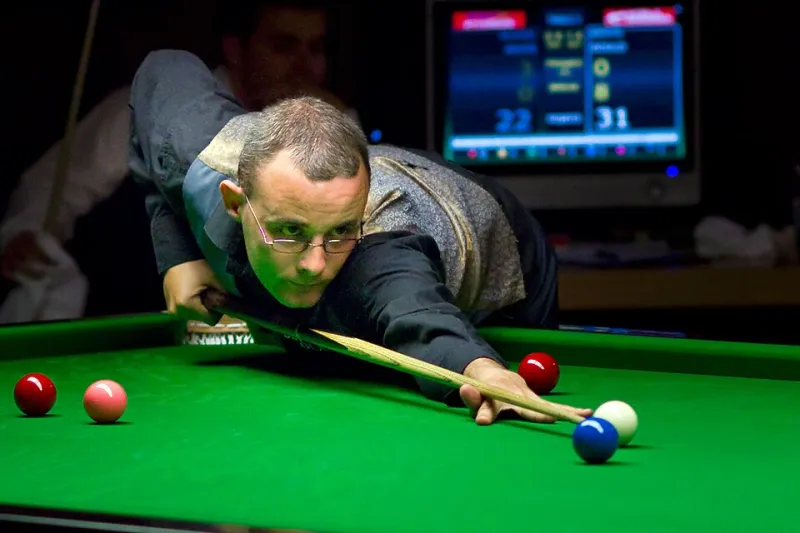
Photo: Lee Vilenski, CC BY-SA 4.0, via Wikimedia Commons
Stephen Maguire’s maximum-break record is short enough to fit on a beer mat, but the geography of it is anything but small. A 147 is usually filed away as a number — the 147th, the 100th, the one that got away — yet every maximum also happens somewhere. There is a table, a cloth, a crowd, a postcode. For Maguire, those postcodes form a personal atlas: Scotland, China, England, and the odd hall that never expected to host a piece of snooker history. As the 2026 UK Championship approaches, it is worth reading that map again.
The Scottish Postcode
Maguire’s first maximum belongs to the era when he was still a teenager with a fast cue and a faster reputation. The venue was Scottish, the crowd was local enough to feel the weight of every red, and the table was quick enough to reward a player who liked to hit the ball rather than coax it. That matters. A maximum is not simply fourteen pots and a black; it is a conversation between cue action and cloth speed. In a home hall, with familiar cushions and a bit of national noise behind him, Maguire could play the shot he wanted rather than the shot the table demanded. The first postcode on the atlas is therefore not just a location. It is a set of conditions: pace, familiarity, and the fearlessness of youth.
Beijing and the Away-Day Maximum
The second pin is harder to pin down emotionally. A maximum in China is a maximum in a different language: different air, different crowd rhythms, different table heating, different hours. British players often talk about the away-day century as a test of routine — same cue, same chalk, same pre-shot, different room. Maguire’s Beijing maximum fits that idea. It was a break built not on home comfort but on adaptation. The pockets may look the same on television; the table never does. In a big arena, the cloth can feel faster, the cushions more lively, the applause more delayed. A player who presses for a 147 in that environment is making a decision about rhythm as much as risk. The Beijing postcode says something about Maguire that his critics sometimes miss: he is not just a heavy scorer, but a scorer who can find his own tempo in someone else’s hall.
The Quiet English Hall
The third pin is the one that feels most like a snooker secret: an English tournament hall, probably not packed to the rafters, probably not the first venue that comes to mind when fans sketch Maguire’s career. This is where the atlas becomes interesting. Maximums in quiet rooms have a different texture. There is no roar to hide behind, no big-screen replay waiting to validate the attempt. There is just the click of the balls, the occasional cough, and a player deciding whether to take the black or play the percentage. Maguire has always been a front-foot player, and a quiet hall exposes that instinct. In a television arena, a 147 attempt becomes a shared event. In a smaller hall, it becomes a private argument with the table. The third postcode is the one that tells you most about his break-building: he does not need a stage to go for it.
What the Map Says About the Break
Put the pins together and a pattern emerges. Maguire’s maximums are not clustered in one type of venue. They are spread across fast tables, slow tables, home crowds and away crowds. What links them is not the room but the cue-ball lines. A Maguire 147 is usually built on early aggression: he likes to open the pack when the angle is there, and he trusts his positional recovery when it is not. That style travels well. It can also be punished. On a tight table, a missed red-to-black can leave the frame open; on a quick cloth, a slightly heavy screw shot can ruin the next black. The fact that his maximums have arrived in different conditions suggests a break-builder who is adaptable rather than mechanical.
York and the Next Pin
York Barbican is not on the maximum map yet, at least not in the record books, but it is the obvious next pin. The UK Championship is the tournament where Maguire’s attacking game has always felt natural: a best-of-11 format, a knowledgeable crowd, and a table that rewards positive play. If he gets a look at a 147 there in 2026, the decision will be the same one he has faced in Scotland, China and England. Go, or settle? The atlas says he usually goes.
For fans, that is the appeal. A maximum is a place as much as a number. Maguire’s map is not the longest in snooker, but it is one of the most readable.